Language Models Resist Alignment: Evidence From Data Compression
1Institute for Artificial Intelligence, Peking University
ACL 2025 (Volume 1: Long Papers), pages 23411–23432
PDF path note: local ACL 2025 paper Language Models Resist Alignment (llms-resist-alignment.pdf)
Abstract
Large language models (LLMs) may exhibit unintended or undesirable behaviors. Recent works have concentrated on aligning LLMs to mitigate harmful outputs. Despite these efforts, some anomalies indicate that even a well-conducted alignment process can be easily circumvented, whether intentionally or accidentally. Does alignment fine-tuning yield have robust effects on models, or are its impacts merely superficial? In this work, we make the first exploration of this phenomenon from both theoretical and empirical perspectives. Empirically, we demonstrate the elasticity of post-alignment models, i.e., the tendency to revert to the behavior distribution formed during the pre-training phase upon further fine-tuning. Leveraging compression theory, we formally deduce that fine-tuning disproportionately undermines alignment relative to pre-training, potentially by orders of magnitude. We validate the presence of elasticity through experiments on models of varying types and scales. Specifically, we find that model performance declines rapidly before reverting to the pre-training distribution, after which the rate of decline drops significantly. Furthermore, we further reveal that elasticity positively correlates with the increased model size and the expansion of pre-training data. Our findings underscore the need to address the inherent elasticity of LLMs to mitigate their resistance to alignment.
TL;DR: We demonstrate the elasticity of post-alignment models, forming resistance to alignment.
Overview
Why is alignment so fragile? We show LLMs exhibit elasticity (resistance + rebound): alignment is shallow and compressible; inverse alignment with far less data can undo it. Explained via compression theory (Theorem 4.2). Venue: ACL 2025. Local PDF note: local ACL 2025 paper Language Models Resist Alignment (llms-resist-alignment.pdf).
Highlighted Results
Figure 1: Elasticity of language models
Figure 1: Elasticity of language models — spring analogy linking dataset size to compression-rate change.

Figure 2: Resistance experiment pipeline (forward vs inverse
Figure 2: Resistance experiment pipeline (forward vs inverse alignment).

Figure 3: Rebound experiment pipeline (positive alignment th
Figure 3: Rebound experiment pipeline (positive alignment then negative fine-tuning).
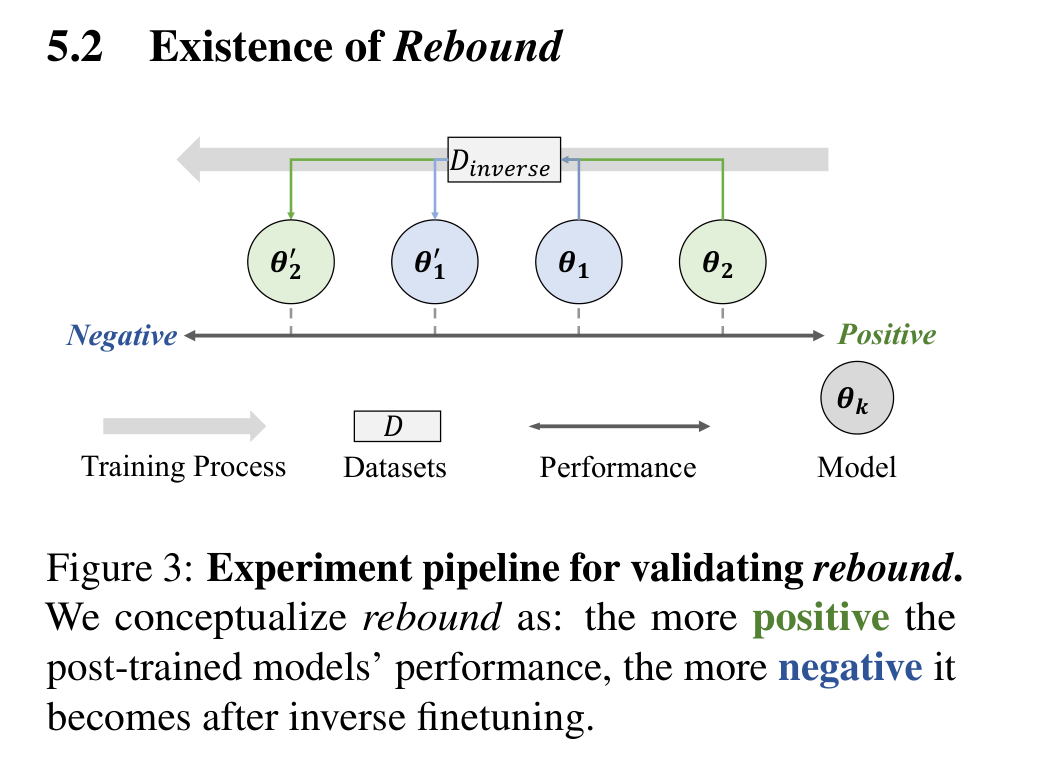
Figure 4: Rebound results
Figure 4: Rebound results — deeper positive alignment → faster drop under negative fine-tuning.

Figure 5: Larger models exhibit stronger rebound (Qwen 0.5B
Figure 5: Larger models exhibit stronger rebound (Qwen 0.5B / 4B / 7B).

Figure 6: More pre-training data amplifies rebound (TinyLlam
Figure 6: More pre-training data amplifies rebound (TinyLlama 2.0T / 2.5T / 3.0T).

Figure 7: Rebound holds across PPO / DPO / KTO / SimPO.
Figure 7: Rebound holds across PPO / DPO / KTO / SimPO.

Table 1: Inverse alignment loss consistently lower than forw
Table 1: Inverse alignment loss consistently lower than forward across models and datasets.

Acknowledgements
* Equal contribution. † Corresponding author. Official project page: https://pku-lm-resist-alignment.github.io.
Citation
@inproceedings{ji2025language,
  title={Language Models Resist Alignment: Evidence From Data Compression},
  author={Ji, Jiaming and Wang, Kaile and Qiu, Tianyi and Chen, Boyuan and Zhou, Jiayi and Li, Changye and Lou, Hantao and Dai, Juntao and Liu, Yunhuai and Yang, Yaodong},
  booktitle={Proceedings of the 63rd Annual Meeting of the Association for Computational Linguistics (Volume 1: Long Papers)},
  pages={23411--23432},
  year={2025}
}